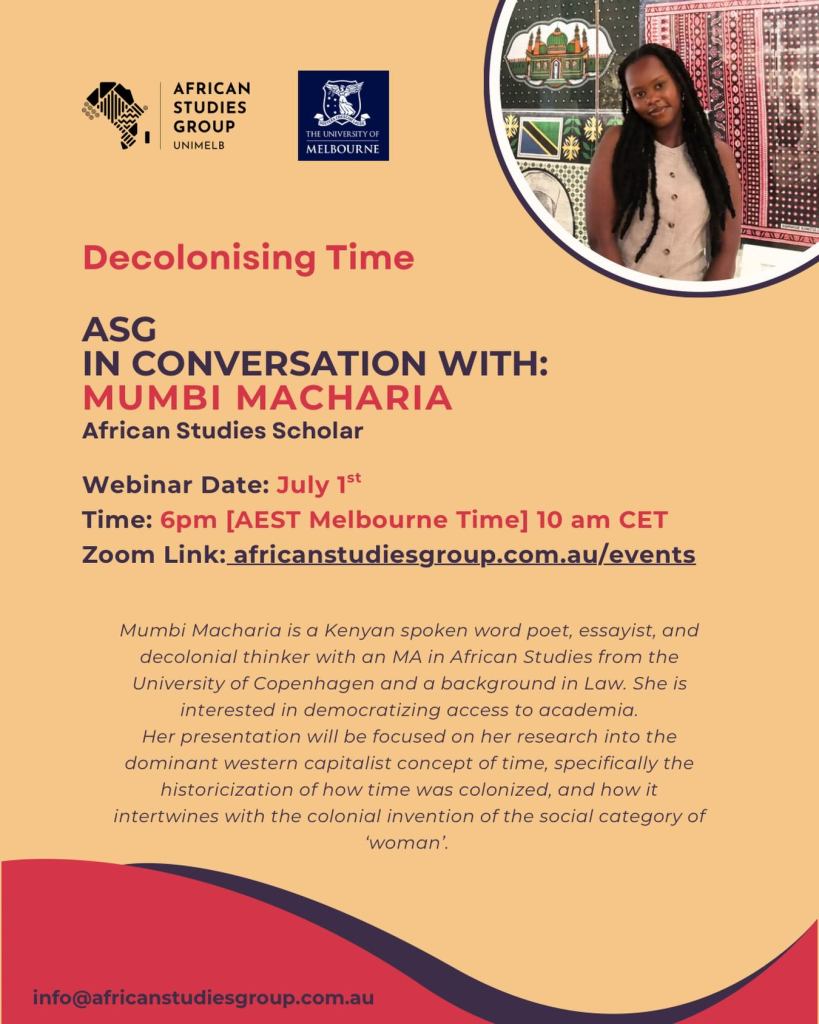
This is an essay presented for the African Studies Group, University of Melbourne July 2026.
Part 1: epistemic apartheid
My overarching academic interest is decolonial epistemology. Epistemology relates to knowledge and how we acquire it, so it’s not just about what we know, but also, how do we know what we know? Because we know that knowledge and power are inseparable (Foucault, 1980). The decolonial part tells us that a lot of the knowledge we consider to be universal or legitimate is largely just western, whereas a lot of our knowledge is often labeled as traditional, local, or indigenous. And there are many decolonial scholars who have written on the need for epistemic plurality, some of my favourites are Ngũgĩ wa Thiong’o (1986), Franz Fanon (1952; 1963), Sylvia Tamale (2024), Ndlovu-Gatsheni (2018), Wangari Maathai, Achille Mbembe (2001), John Mbiti (1969), and so many more.
This marginalization of other ways of knowing actually has a name, epistemic apartheid (Rabaka, 2010), it means marginalization of ways of knowing of those of racially minoritized backgrounds. Gayatri Spivak in her 1988 essay Can the Subaltern Speak? called this marginalization epistemic violence, Ngũgĩ wa Thiong’o in Decolonising the Mind (1986) called it the cultural bomb, Franz Fanon in Black Skin White Masks and The Wretched of the Earth said that colonization didn’t only dispossess us of land and material things, but it also took away the colonized’s ability to name the world, and in her essay A is for Africa (2024), Sylvia Tamale described this epistemic apartheid as the Big Lie.
Tamale writes, ‘The world is living one Big Lie which mandates conformity into western ways of thinking, being and doing’ and this is seen through the colonial lens in various aspects of life, including in our understanding of gender, and the concept of time.
Part 2: the coloniality of time
This brings me to the second part of this essay, where my aim is to show that even the way we understand and perceive time was colonized, and that the dominant way of perceiving time which we think is universal is just one way, but this should not stop us from exploring other ways of understanding time. I primarily use Mbiti’s framework, however for further reading on time and epistemic plurality, also see Wiredu (1980), Gyekye (1995), Mbembe (2001), and more.
So you know how people often joke about ‘African time’ (or if you are Kenyan, ‘Kenyan time’) as if it means lateness or disorganization? well, let me tell you that this connotation is actually a colonial reading. Primarily here I want to discuss John Mbiti’s 1969 African Religions and Philosophy, where he has a chapter on African notions of time. For context Mbiti was a theologian and in an attempt to understand traditionally the relationship that African peoples have with God and their religious ontology, we must first understand how African peoples traditionally perceive time. This is what led Mbiti to find some fundamental differences between the dominant western concept of time, and traditional African perceptions, of course by using these terms western or African I am not trying to essentialize, we know that Africa is not a monolith, neither is the west, rather this is just to compare and contrast different ways of perceiving time.
The dominant western way of perceiving time is very linear and 3 dimensional in the sense that there is a distinct separation between the past, present, and future, linear in the sense that it sees time as a line that we move forward through, so this is where we get ideas of progress sand development, and it sees the future as an empty container waiting to be filled, and time is something finite that will eventually come to an end.
We know also from capitalism that if something is finite, it makes it a commodity, something scarce that could eventually run out, and this is where the commodification of time comes from. It also places a strict sense of urgency in how we use our time, but I will come back to this in just a moment.
On the other hand, Mbiti found that form the African communities he surveyed, traditionally African peoples perceive time as relational, event based, and in 2 dimensions.
He used Kiswahili words to describe these dimensions: zamani which is ‘the infinite ocean of time where everything gets absorbed into an aspect of reality which is neither after nor before’ and sasa, which is ‘the period of time within which people exists, and within which they project themselves into the past and future’. Just a note on language, it is often mistranslated that zamani means the past and sasa means the present, but according to Magdy (2020) this is the worst injustice one could make to Mbiti’s work.
The most important takeaway for me from Mbiti’s analysis is that in traditional African thought, time is infinite, it has no end, it is a spiral that loops in on itself. From a religious standpoint as Mbiti writes, this means that ‘there is no heaven to be hoped for or hell to be feared‘.
The consequence of capitalist time is because time is a commodity, i.e. something that can be spent, saved, wasted, or lost, is that it creates a binary between what is productive vs unproductive use of time. And this leads me to the next part on the invention of women (phrase borrowed from Oyěwùmí 1997).
Part 3: the colonial invention of the social category ‘woman’
One thing that colonialism invented through capitalism was binaries, and we know this from a gender analysis. Prior to colonialism in Africa, we know that across many communities there were diverse roles for men and women, however they were not founded on existential epistemology of othering of the sexes (Ipadeola, 2023). It means roles were not strictly masculanised or feminized.
Tamale (2024) writes, ‘The cultural systems that order African understandings of gender are so fundamentally alien to Western ways of thinking that they appear irrational. While colonial paradigms of gender are firmly founded on polarised dualisms of man/woman, African indigenous understandings of the same were more pluralistic, elastic and accommodating’.
Colonialism introduced binaries between the public and private sphere, between market and domestic, between production and reproduction, and it accorded different rights and privileges to each sites. Some sites were masculanised like the public, the market, production, and these sites were waged. Other sites were feminized like the private, the domestic, reproduction, and this was unwaged. The masculine sites were therefore considered to be active, and the best productive use of time, while the feminized sites were passive.
So I think it is very important in the reading of Mbiti to understand that when we talk about African notions of time or when we use a universal ‘we’, that it’s actually not a blanket statement, because African women have historically been the other of the other (Ipadeola, 2023), marginalized both on racial and gender grounds.
But back to this issue of masculine sites being productive and active and feminized sites being passive, Tamale again writes,
‘The foundational colonial construction of men as productive breadwinners and women as unproductive caretakers further creates a gender hierarchy that subordinates women. It did not resonate with most African societies where many women routinely engaged in trade, commerce, agriculture and control of property prior to the interventions of the colonialists.’
And just to give an illustration of how the coloniality of time intertwinses with the colonial construction of gender, I will give an illustration of the women of Maragua in central Kenya in the 1980s.
Historically in Kikuyuland, women were in charge of the farms, here it was coffee farms, and in the 1980s due to drops in coffee prices, the women of Maragua wanted to abandon the crop, but then the World Bank started paying men directly to incentivize them and their wives to continue growing coffee (Kaara et al., 1997), because of the idea that men were the breadwinners and so they were the ones who were waged.
The effect of this is that it made the women become dependent. By the end of the 1980s the women had received almost noting for their work done on the farms, because their sphere was unwaged, and in a later report to the World Bank the women said the men owned everything, including their labour (Kaara et al., 1997).
Women’s time was therefore drastically shifted from being active, to passive. They no longer had agency of their own time, because if you are constantly told that your labour is domestic, reproductive, passive, unwaged, that you are dependent, it means that you are stuck in an eternal NOW, or an eternal sasa of survival and you are not capable of projecting yourself into the future or past, because capitalist time says the only productive way to experience time is to participate in capitalist productivity. And this is a weaponization of time to justify gender hierarchies.
My suggestion therefore is that we need to realize that we all don’t experience time in the same way, and that idea of time being linear locks out so many people because they are made to feel like they are being passive.
Mumbi, 1st July 2026.


Leave a Reply